dadbot
In early 2023, my 10-year partnership with a cis-man who I thought I’d spend the rest of my life with completely fell apart. While I was in my grief, I began to hear the voice of my dad who died in 1994, like he was having a conversation with me in my head. I’m curious about the connection between this epic failure of my relationship with a man, and the sudden presence of the missing patriarch in my life.
Inspired by the fad to recreate deceased loved ones through AI, DADBOT is my attempt at resurrecting my dead dad in performance using the same technology, and to simulate the iconic father-child conversation. I’ll be using two seminal texts about my family: a Japanese booklet written in 1974 by my deceased father Tosh Lee attempting to map out his Zainichi Taiwanese family tree (“Zainichi” refers to the people residing in Japan who’ve been ethnically Othered due to imperialism and oppression caused by Japan). And the other is a Japanese book written by my mother Aoi Lee published by Tokyo Shoseki titled アメリカ的ガン闘病記―すべては告知から始まった (An American Cancer Story: It All Started with a Diagnosis) about her experience of being beside my father while he was dying of cancer. I am working closely with Haruka Ueda, a translator and playwright based in Japan, and our hope is to complete all translations by the end of 2027.
Additionally, I’ve been in touch with scholar Hwaji Shin at the University of San Francisco who I previously worked with on the AppleTV+ series Pachinko, who researches citizenship, migration and nationalism in Japan. She has connected me with Leo Ching, professor at Duke University, who studies colonial histories in Taiwan. By the end of 2026, I hope to make a research trip to Japan and Taiwan to meet with extended family and collect more stories about my father and to check-in with Haruka in-person. All of this collected data will be fed to an AI “Dad” that we will build from scratch while also utilizing popular functions like chatbots, deepfakes, and translators to talk to him.
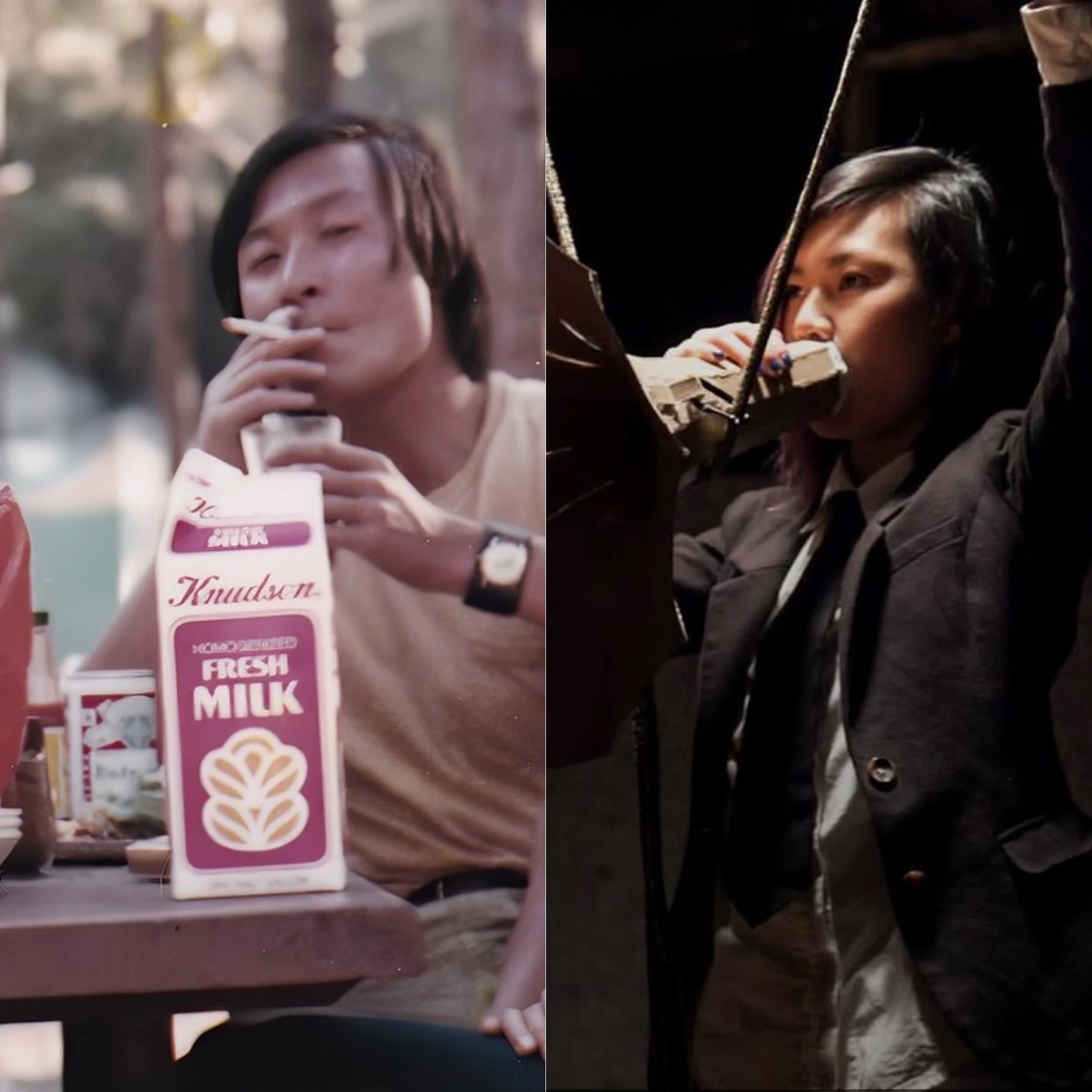
On the left: Tosh Lee. Santa Monica, CA, 1972. On the right: Haruna Lee. Brooklyn, NY, 2013.
The performance itself will be a mix of scripted and non-scripted improvisation between myself and the AI that will feel much like a two-person public dialogue or an irreverent low-budget talk show like ‘Between Two Ferns’ where we’ll discuss his experience of migration, growing up Taiwanese in Japan, and the culturally forbidden love between him and my mother. I will show him reenacted scenes from my 10-year polyamorous relationship, its joys and failures of it, and receive “fatherly advice”. We’ll also gaze at different versions of “Daddy” as it appears in popular culture, power dynamics, and kink, and discuss how rebelliousness has been a motivation in both our lives. And finally, I want to ask his permission to play him on stage.
At the heart of this piece is my yearning to understand the ties between fatherhood, rebelliousness, and romantic love. I want to capture a spiritual levity in “raising the dead”, while interrogating AI’s application in grief work. The performance will be durational in that, we’ll resurrect my dad on opening night, and then on closing night, we’ll permanently delete him.
collaborators
I have two collaborators on this project, Jared Mezzocchi (two-time Obie Award-winning director and muti-media designer) and Kento Morita (actor and Anthem Award-winning conversation designer for AI). Much of our conversations and ideating so far have been around the technology and practicality of building an AI “Dad”, as well as the more existential and ethical questions about the impact of AI on climate, the human race, truth, and bias. This residency and commission would be such a gift to us, to have uninterrupted time in a room together to start investigating these ideas in real-time. One experiment we’re keen on trying out is feeding the AI data about my dad and exploring the scope of its conversation. We would retroactively have to program the AI to deal with certain limitations (turns out, AI has a hard time talking about death), and we've been deep in discussions about how to create an emotional track for the bot. The other option is to create a script for the AI (and we can use technology/AI for this, or not) and have an actor voice the AI as we engage it in conversation. In either scenario, we would be exploring a "happy path" for the AI, as well as any deviations, and are perhaps more excited over what the deviations can yield. The second experiment is the collaboration itself. Jared, Kento, and myself have never worked together, and we're eager to discover what our working dynamic is like. At this point we haven't really assigned any roles, other than that I will ultimately write this piece and have some hand in performing in it, but we're really coming at it as a think tank or brain trust first, and hoping to solidify our creative roles as we go. Collaborators who I don’t have yet but would love to connect with in Minnesota include a few male actors of Asian descent of varying ages, as well as a dramaturg (preferably a woman of color).
development
This project has received support from the Guggeheim Fellowship (2026), the Creative Capital Award (2026), the Mercury Store Residency (2026), and the Berkeley Rep Ground Floor Series (2025).
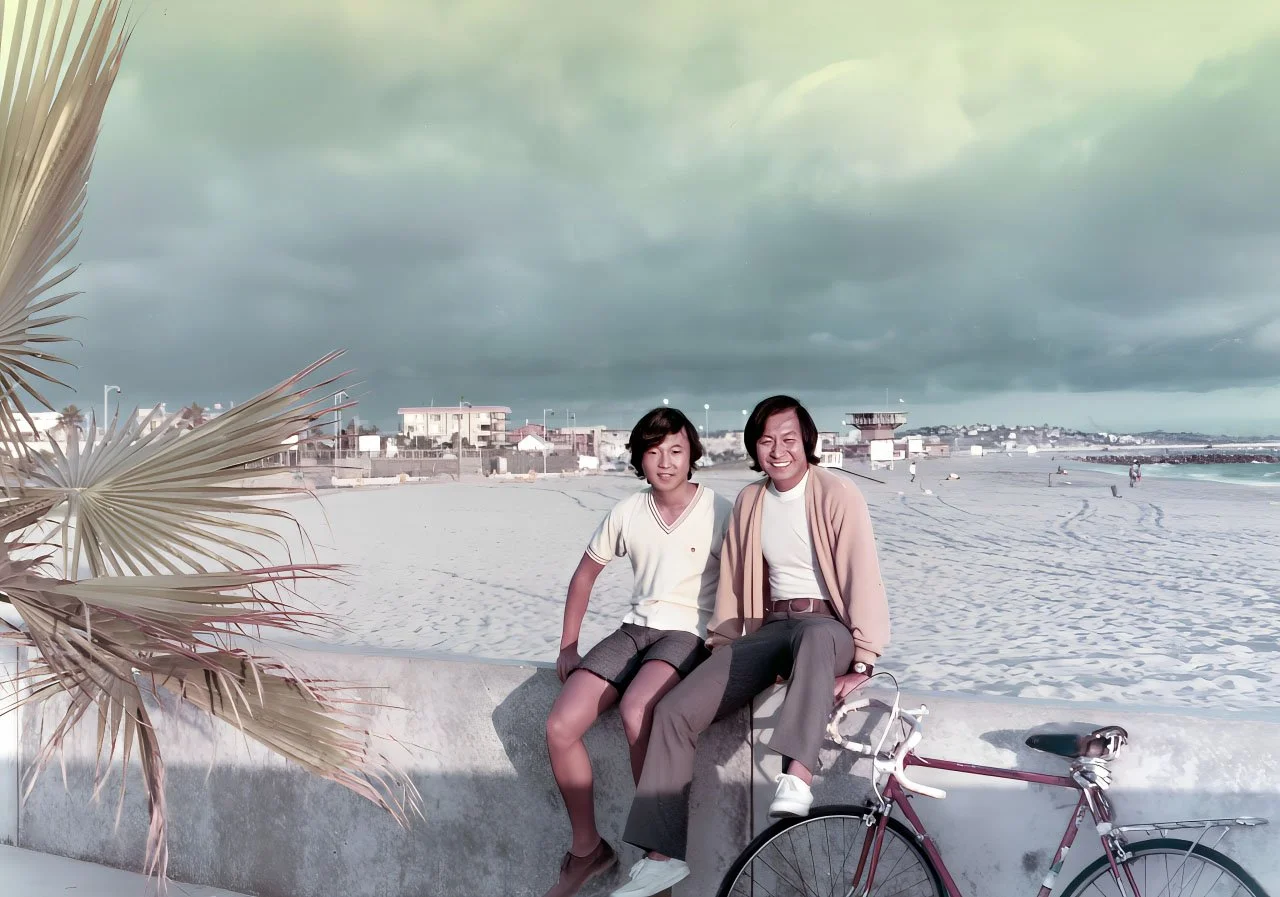
Hiro Lee and Tosh Lee. Santa Monica, CA, 1972. Photo courtesy of Hiro Lee.